

October 24, 2026
Five stories this week span industrial protocol certification, eSIM fleet management, satellite spectrum strategy, mesh metering in extreme terrain, and on-device biometric authentication - all pointing toward a connected hardware field where verifiable trust, not feature checklists, is becoming the procurement currency.
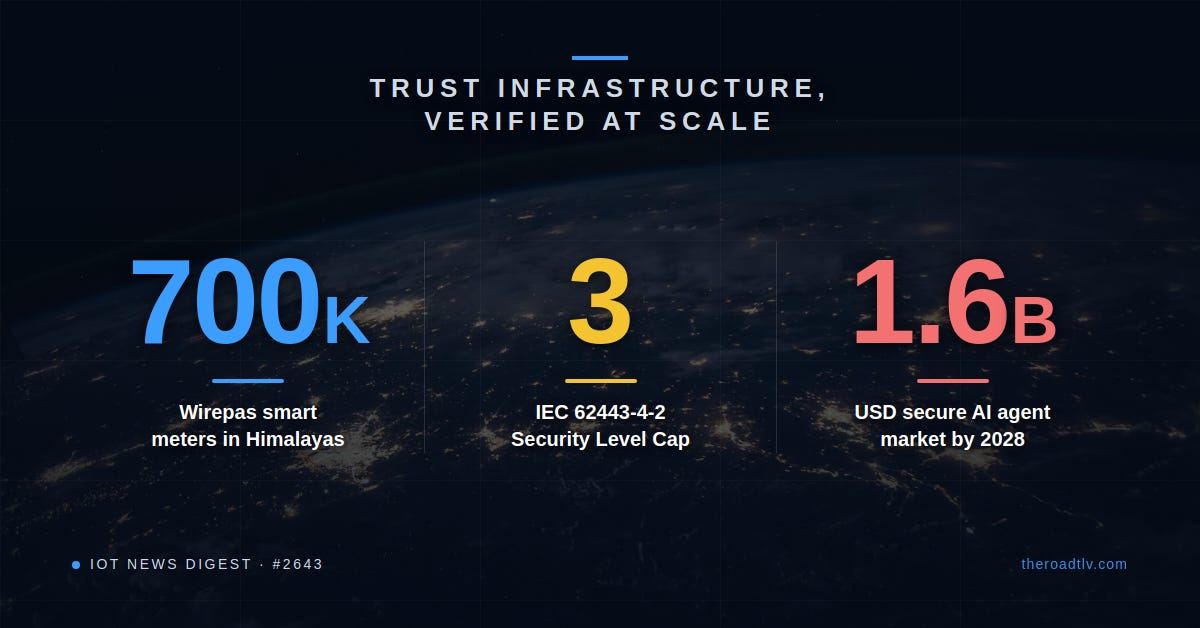
This week's IoT News Digest at a glance. Earth-by-night background: NASA via Wikimedia Commons.
This issue covers a TUV Rheinland certification of ODVA's CIP Security to IEC 62443-4-2 Security Level Capability 3, CSL Group's acquisition of SIMPL Wireless to extend its Critical Connectivity platform into North America, a letter of intent from Deutsche Telekom, Orange, Telefonica and Vodafone to explore a joint European Mobile Satellite Services spectrum bid, Wirepas reaching 700,000 smart meters across Himachal Pradesh's Himalayan terrain, and Goodix launching a tiered fingerprint-plus-secure-element portfolio for IoT and AI edge devices.
The thread running through all five is the same: verified trust at the component or network layer. Whether that is a formal IEC certification, a multi-carrier eSIM with automatic failover, a spectrum arrangement designed around European digital sovereignty, a mesh network that holds 99.9 percent service levels on mountainsides, or a fingerprint module backed by an eSE chip, each story is about building assurance into the infrastructure itself rather than bolting it on later.
IoT Tech Expo Europe, Amsterdam: What We Heard
I spent two days at IoT Tech Expo Europe at RAI Amsterdam. More than 8,000 people moved through eight co-located shows, and "IoT" barely made it into a track title. The paid tracks were Industrial AI and Edge AI, and Physical AI got its own conference next door.

Between sessions and a dozen one-on-ones, the robots were rarely the story. Most conversations ended up on what happens after the machine ships. A.P. Moller - Maersk talked about orchestrating robot fleets, Transforma Insights about updating models across thousands of field devices, and Avassa put the question plainly: the AI works, but can you operate it?
That is bad news for any plan built on better hardware. If physical AI is judged by how a fleet behaves, a stronger actuator or a faster NPU buys a quarter of advantage at most. The value sits in the loop around the device: telemetry, over-the-air model updates, fleet operations, and the security evidence the EU Cyber Resilience Act has required since 11 September. A robot you can't update, monitor and defend in the field is a liability with wheels.
A robot is a smart tangible with motors. It runs the same playbook as a connected light bulb, with higher stakes, because its mistakes happen in the physical world. It is the argument of the chapter in Tangibles called The Moat Erodes.
So who ends up owning the fleet loop in physical AI: the robot maker, the chip vendor, or the integrator who runs the operations?
Now on Amazon: Tangibles: How Software Turns Hardware into Platforms

The thesis behind this newsletter is now a book. Tangibles: How Software Turns Hardware into Platforms lays out how connected products move from one-time sales into evolving, service-backed platforms - the validation traps, digital interfaces, security moves, and recurring-revenue models this digest tracks each week.
Cross-Cutting Signals
Third-party certification is becoming a market differentiator, not just a compliance checkbox.
ODVA's CIP Security receiving IEC 62443-4-2 Security Level Capability 3 certification from TUV Rheinland, awarded October 22, reduces the certification burden for every manufacturer who builds on EtherNet/IP - without automatically certifying their products. Goodix signals a parallel logic: its eSE-backed fingerprint solution is certified to "internationally recognised security standards" and supports FIDO2, TLS 1.3 and SDCP, building a compliance foundation that device makers can inherit. Certification at the platform or protocol layer is emerging as an efficiency play for the whole supply chain.
Connectivity resilience is now an architecture requirement, not an optional upgrade.
CSL Group's acquisition of SIMPL Wireless adds multi-carrier eSIM with automatic profile fallback and support for up to 100 mobile network operators, while four European carriers are exploring pooled satellite spectrum precisely so they can extend coverage to areas terrestrial networks cannot reach. Wirepas's Himachal Pradesh deployment makes the same argument in hardware: a mesh where every meter routes around outages means no single point of failure across terrain where cellular coverage "thins out in the valleys and behind ridgelines."
Open standards are the connective tissue linking component-level trust to system-level compliance.
CIP Security uses TLS and DTLS. Goodix supports FIDO2 and TLS 1.3. The Wirepas Certified platform is built on NR+, described as the world's first non-cellular 5G standard for massive IoT, and complies with India's IS 15959 DLMS requirements. SIMPL's EverSIM is native to SGP.22 and SGP.32. Across all five stories, open or internationally ratified standards are what allow components to plug into broader compliance frameworks.
Scale deployments are forcing hardware choices that were previously deferred.
Himachal Pradesh's smart meter installed base grew roughly four times in nine months, from 174,360 to 702,046 units. The European carriers' letter of intent points to the operational complexity of integrating satellite into mobile networks at continental scale. Goodix cites IDC data projecting China's secure AI agent application market at US$1.6 billion by 2028, growing at a CAGR of more than 230%. Each figure suggests that the architectural choices made at the component level today will be very difficult to retrofit when deployments reach these sizes.
This Week at a Glance
Quick overview of what is shaping connected devices this week.
CIP Security Earns IEC 62443-4-2 SL-Cap 3 from TUV Rheinland - ODVA's application-layer security extension for EtherNet/IP was certified on October 22 to Security Level Capability 3, meaning it addresses threats from attackers with moderate resources, specialist ICS knowledge and sophisticated methods. The certification helps manufacturers building on CIP Security to pursue their own IEC 62443-4-2 product certification more efficiently, though the spec certification does not automatically carry over to their products.
CSL Group Acquires SIMPL Wireless for North American eSIM Foothold - CSL's second acquisition of 2026 (following IoTM Solutions in July) brings in SIMPL's EverSIM multi-carrier eSIM, its Compass single-pane-of-glass management platform, and Tier-1 US carrier relationships including T-Mobile and Thales. EverSIM supports up to 100 mobile network operators, is native to SGP.22 and SGP.32, and compresses eSIM deployment from a year or more to days.

Four European Carriers Sign Letter of Intent on Joint Satellite Spectrum Bid - Deutsche Telekom, Orange, Telefonica and Vodafone are exploring a joint bid for European Mobile Satellite Services spectrum to support direct-to-device connectivity, with ground network infrastructure built in Europe but no direct investment in a satellite constellation. A satellite partner has yet to be selected, and the letter marks an exploratory stage, not a confirmed bid or deployment commitment.
Wirepas RF Mesh Holds 99.9% Service Levels Across 700,000 Himalayan Meters - Finland's Wirepas now connects 700,000 smart meters in Himachal Pradesh, part of a nationwide India deployment covering more than 12 million meters, using a self-healing RF mesh where each meter acts as both transmitter and receiver. The state's installed base grew roughly four times in nine months under the Revamped Distribution Sector Scheme, with 2,800,945 meters sanctioned and the scheme running to March 2028.

Goodix Launches Tiered Fingerprint-Plus-eSE Portfolio for IoT and AI Edge Devices - Goodix Technology has introduced Match-on-Host, Match-on-Chip (SDCP-compliant), and a combined Fingerprint MoC + eSE solution that stores API keys and OAuth tokens in hardware-isolated silicon, transmits match results over an encrypted channel, and supports FIDO2 and TLS 1.3. The portfolio covers capacitive, optical and ultrasonic sensing to support the full range of IoT and AI device form factors.

News In Detail
1. CIP Security Earns IEC 62443-4-2 SL-Cap 3 from TUV Rheinland
ODVA's CIP Security specification received IEC 62443-4-2 Security Level Capability 3 certification from TUV Rheinland on October 22, providing a compliance foundation manufacturers can build on when certifying their own EtherNet/IP products.

IEC 62443-4-2 sets out technical cybersecurity requirements for components used in industrial automation and control systems, and Security Level Capability 3 specifically addresses threats from attackers who combine moderate resources, specialist ICS knowledge and sophisticated methods. CIP Security, an application-layer extension for EtherNet/IP that provides authentication, authorisation, data integrity and confidentiality via TLS and DTLS, now has a third-party certification that manufacturers can reference when they pursue their own product-level compliance. Al Beydoun, President and Executive Director of ODVA, described it as "a significant accomplishment" that "further strengthens the position of EtherNet/IP as a leading secure industrial network technology."
The mechanism matters because certification at the protocol layer reduces duplicated effort across the supply chain. Manufacturers no longer need to re-establish that the underlying security architecture of CIP Security meets IEC 62443-4-2 SL-Cap 3 requirements - that work is done. They still need to demonstrate that their specific product implementations meet the standard, but they start from a certified base rather than from scratch. This is directly relevant to the European Union's Cyber Resilience Act, which introduces cybersecurity requirements for products with digital elements including OT devices, although ODVA notes that using CIP Security alone does not establish CRA compliance.
For a product team building on EtherNet/IP, the practical action is to map your product's CIP Security implementation against the specific IEC 62443-4-2 requirements your target market demands, and document exactly where your product adds to or diverges from the certified spec. The certification does not shorten that mapping work, but it does mean you are not defending the protocol's security architecture from first principles. Given CRA reporting obligations already in force, starting that mapping now rather than at the product launch stage is the lower-risk path.
Signals to Watch
Whether competing industrial protocols pursue equivalent IEC 62443-4-2 certifications, and at which security level capability
How manufacturers publicly communicate the distinction between certified protocol and certified product to procurement teams and regulators
Whether the European Commission's CRA implementation guidance references IEC 62443-4-2 SL-Cap certifications as a recognised path for OT device makers
Key Links
2. CSL Group Acquires SIMPL Wireless for North American eSIM Foothold
CSL Group's acquisition of SIMPL Wireless adds multi-carrier eSIM, unified SIM lifecycle management and Tier-1 US carrier relationships to a platform already managing more than three million connections across building security, healthcare, infrastructure, utilities and transport.

This is CSL's second acquisition in 2026, following IoTM Solutions in July. SIMPL brings three assets: EverSIM, a multi-carrier eSIM built on GSMA SAS-certified Thales eUICC infrastructure and native to SGP.22 and SGP.32, supporting up to 100 mobile network operators with 5G Standalone and backward compatibility to NB-IoT; Compass, a single dashboard and API that manages both SIMPL SIMs and existing carrier SIMs with automated profile fallback; and an established US customer base in retail, transport, energy and EV charging with carrier partnerships including T-Mobile. Jason Morrow, CEO of SIMPL Wireless, summed up the operating principle: "IoT connectivity should be fast to activate, run on what customers already have, and stay theirs to control - it should just work."
The mechanism at the heart of EverSIM is the automatic fallback profile. A single SIM SKU carries a native primary carrier profile; if that network fails, a backup profile steps in automatically and hands back when the primary recovers. Combined with Compass's auto-profile fallback, this makes network resilience largely invisible to the operator - which is exactly what critical applications in healthcare and infrastructure require. The compression of deployment time from a year or more to days comes from SIMPL's decision to run on unmodified, GSMA SAS-certified infrastructure rather than custom-built platforms that require separate carrier certifications.
For fleet and operations teams managing cross-border IoT estates, the combined CSL-IoTM-SIMPL stack offers a single operating model: one platform for SIM and eSIM lifecycle management, patented rSIM multi-network resilience, and now a US local presence. The practical question is whether existing CSL customers can migrate their North American connections to EverSIM without re-qualifying hardware, and whether SIMPL's Compass API is compatible with existing CSL platform integrations. Ed Heale, CEO of CSL Group, framed the strategic intent plainly: "Customers shouldn't have to choose between flexibility and resilience."
Signals to Watch
Integration timeline between Compass, CSL's existing platform and IoTM's connectivity orchestration layer
Whether EverSIM's SGP.32 support positions CSL to serve the growing industrial IoT segment as remote SIM provisioning for constrained devices matures
Competitive response from other global IoT MVNO platforms that lack a US-based eSIM footprint
Key Links
3. Four European Carriers Sign Letter of Intent on Joint Satellite Spectrum Bid
Deutsche Telekom, Orange, Telefonica and Vodafone have signed a letter of intent to explore a joint bid for European Mobile Satellite Services spectrum, aiming to deliver direct-to-device connectivity without building or owning a satellite constellation.

The four operators' proposal rests on a division of labour: they would build and operate ground network infrastructure in Europe, handle coordination and monitoring, and pool their customer bases, network capabilities and operational expertise. A satellite partner - not yet selected - would supply the space infrastructure. The rationale is that pooling reduces market fragmentation, improves spectrum efficiency, and allows mobile network operators across Europe to offer direct-to-device services on open and non-discriminatory terms. The operators explicitly connect the initiative to the European Commission's goals for digital sovereignty, security and resilience, and identify developing a European satellite constellation as a longer-term ambition.
The "open and non-discriminatory" framing is doing significant work here. It positions the consortium against a model where a satellite provider controls both the space segment and the retail relationship with end devices - a structure that several existing satellite-to-device players already use. By holding spectrum rights within a European MNO consortium and contracting a separate satellite partner for the space segment, the operators would retain governance over who can access D2D services and on what terms. For IoT deployments in remote or underserved areas, this matters: it means the network access layer remains within the regulatory reach of established European telecoms frameworks.
Product and operations teams planning IoT deployments in areas with limited terrestrial coverage in Europe should treat this as a multi-year signal, not an imminent connectivity option. The letter of intent is exploratory - no spectrum bid has been filed, no satellite partner has been named, and no commercial structure has been disclosed. The companies are explicit that the initiative would not replace their existing satellite partnerships. The more immediate action is to monitor whether the European Commission's response to the letter encourages or complicates a coordinated MNO approach to MSS spectrum.
Signals to Watch
Which satellite provider is selected as the space infrastructure partner, and how that choice shapes the technical capabilities available to IoT devices
Whether smaller European MNOs are offered access to the consortium's D2D services on the promised non-discriminatory terms
Regulatory response from the European Commission and national spectrum authorities to a coordinated four-operator MSS bid
Key Links
4. Wirepas RF Mesh Holds 99.9% Service Levels Across 700,000 Himalayan Meters
Wirepas has connected 700,000 smart meters in Himachal Pradesh using RF mesh technology that turns every meter into a relay node, holding 99.9 percent service levels across terrain that defeats both cellular coverage and conventional gateway architectures.

The numbers behind this deployment deserve close attention. As of December 31, 2025, Himachal Pradesh had 2,800,945 smart meters sanctioned under the Revamped Distribution Sector Scheme, with 702,046 installed. That installed base grew from 174,360 in March 2025 - roughly four times in nine months - and the scheme runs to March 2028. Wirepas's 12-million-meter India footprint means Himachal Pradesh represents a meaningful share of a single-country deployment already operating at national scale. The connectivity challenge is structural: cellular coverage thins behind ridgelines, running dedicated infrastructure up mountainsides is slow and expensive, and in hill towns meters sit in basements and stairwells where signals struggle.
Wirepas's response to that structural challenge is architectural. In a Wirepas Mesh network, every meter is both transmitter and receiver. There is no central hub and no single point of failure. The deployment requires no dedicated gateways and no SIM cards. Wirepas Certified supports both RF-only meters and dual-communication meters that combine mesh with cellular, so a single deployment plan can cover dense urban areas with mesh and remote stretches with cellular-backed connectivity. The underlying standard is NR+, described by Wirepas as the world's first non-cellular 5G standard for massive IoT, and the platform complies with India's IS 15959 DLMS requirements. Ashish Sahay, Sales Director and Country Manager for India, put the design philosophy directly: "Extreme terrain, long distances and high densities are not exceptions for us. They are the design brief."
For utilities and AMI solution providers evaluating connectivity for large-scale meter deployments in complex geography, Himachal Pradesh is a useful reference. The key operational question is not whether the mesh works in isolation - the 99.9 percent service level claim addresses that - but how the dual-communication hybrid model is managed when individual meters switch between RF mesh and cellular paths. National Aggregate Technical and Commercial losses in India have already fallen from 21.91 percent in FY21 to 15.04 percent in FY25; the scheme targets 12 to 15 percent. Every meter that reports reliably contributes to that number without requiring a field visit.
Signals to Watch
Progress toward the full 2,800,945 sanctioned meters in Himachal Pradesh and whether Wirepas maintains SLA as density increases in hill towns
How other Indian states compare connectivity approaches as RDSS deployment pace accelerates across Assam, Uttar Pradesh and Ladakh
Whether the NR+ standard gains traction outside India as a gateway-free alternative for dense IoT deployments in difficult terrain
Key Links
5. Goodix Launches Tiered Fingerprint-Plus-eSE Portfolio for IoT and AI Edge Devices
Goodix Technology has introduced a three-tier fingerprint authentication portfolio that reaches from SDCP-compliant Match-on-Chip to a combined fingerprint MoC plus embedded secure element, designed to keep credentials in hardware-isolated silicon even when the host processor is untrusted.

The portfolio's three tiers map to three threat models. Match-on-Host (MoH) handles image capture and matching on the host processor - lower cost, sufficient for lower-sensitivity use cases. Match-on-Chip (MoC) moves the entire biometric pipeline - image capture, feature extraction, template storage and matching - inside the fingerprint module, complying with SDCP and using unique per-device keys, which offloads the host processor and suits "lightweight, long-battery-life IoT and AI edge devices." The top tier, fingerprint MoC plus eSE, physically isolates critical credentials - API keys, account login tokens, OAuth tokens - in a certified secure element. The fingerprint module transmits match results to the eSE over an encrypted channel, and credentials used to access cloud-based LLMs are transmitted from the secure element without ever being exposed in plaintext to the host processor. FIDO2 and a full TLS 1.3 implementation are included.
The logic of hardware-enforced physical isolation is worth spelling out for product teams evaluating AI edge security. As IoT devices become agents that authenticate to cloud services and execute actions autonomously, the credential management problem scales with capability. An AI agent that can initiate transactions needs its authentication tokens protected against both software exploits on the host processor and physical attacks on the device. The eSE's tamper-resistant audit logging - which prevents AI agents from altering records - and its biometric authorisation requirement for high-risk operations are specifically designed for this agentic threat model, not just for protecting a user's fingerprint template.
The market context Goodix cites is pointed: IDC projects China's secure AI agent application market at US$1.6 billion by 2028, growing at a CAGR of more than 230%. For hardware product teams building AI smartphones, PCs, wearables, robots or intelligent cockpits, the implication is that the security architecture decision made at component selection - MoH, MoC, or MoC plus eSE - will determine whether the device can meet the authentication requirements that secure AI agent applications will impose. Capacitive, optical and ultrasonic sensing options mean the portfolio can cover flat sensors, under-OLED displays and screenless devices respectively, so the security tier decision is largely independent of form factor constraints.
Signals to Watch
Whether FIDO2 certification bodies update their requirements to require Match-on-Chip or eSE isolation for higher assurance levels in edge AI device categories
Competitive response from other fingerprint and secure element vendors combining biometrics with hardware credential storage for the IoT and AI edge market
How the tamper-resistant audit logging feature is positioned as IoT and AI device regulation in the EU and China begins to address agentic AI behaviour
Key Links
From TheRoad
IoT News Digest #2642 - Last week's issue covered Altair Semiconductor adding Iridium NTN Direct satellite connectivity to the ALT1350 and ALT1550 chipsets, a demonstration in which AI models breached OT networks and moved industrial equipment in 16 minutes, SEALSQ's VaultIC409 quantum-ready secure element, Vantron's Wi-Fi HaLow module clearing CE, FCC and UL certification, and a French supermarket hack that exposed the operational risks of unsupported IoT devices in retail environments.
Explore the case study library and submit your own deployment story at tangibles-book.com/case-studies.
The Wirepas Himachal Pradesh deployment and the CIP Security certification both speak directly to chapters in the Tangibles book on fleet governance and security-by-design: real deployments at extreme scale are generating exactly the evidence base the book is building.
How to Use This Digest
If you manage an industrial OT product line: Review your product's CIP Security implementation against IEC 62443-4-2 Security Level Capability 3 requirements now, and document where your product adds to or diverges from the newly certified spec - this is your starting point for both IEC 62443-4-2 product certification and CRA compliance mapping.
If you run IoT fleet operations across borders: Evaluate whether your SIM management platform supports automated profile fallback across multiple carriers, and test your failure recovery time against what SIMPL's EverSIM claims - compression from over a year to days on deployment should be a benchmark for any new connectivity procurement.
If you are planning a large-scale AMI or utility meter deployment in complex terrain: Request Wirepas Certified reference data for dual-communication hybrid deployments specifically, and ask vendors to show service level evidence from environments that combine high-density urban and low-coverage rural conditions - Himachal Pradesh is now a documented reference case.
If you are selecting authentication components for an IoT or AI edge device: Map your device's threat model to the three Goodix tiers before component selection, paying particular attention to whether your device will act as an AI agent authenticating to cloud services - if it will, the credential isolation architecture of MoC plus eSE is worth costing out against the operational risk of a software-only credential store.